Payment Methods
Crypto Casinos in Canada: Deposit & Withdraw Safely
How Canadian players deposit and withdraw crypto at online casinos — near-instant transfers, network fees, KYC triggers, and when Bitcoin beats traditional banking.
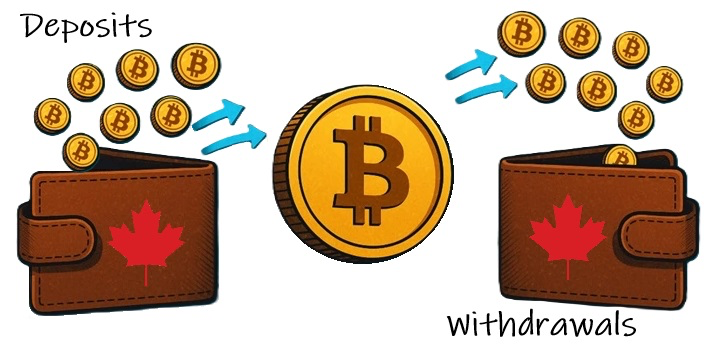
Crypto casinos offer Canadian players a fundamentally different way to move money in and out of a player account. Instead of relying on Interac, credit cards, or bank transfers — all of which can be delayed, blocked, or subject to fees and scrutiny — you send cryptocurrency directly from a self‑custodied wallet to the casino's blockchain address. The casino only sees the transaction on the ledger, not your name, your bank, or your credit history.
This structure means near‑instant deposits, automated payouts that don't wait for banking hours, and a degree of financial privacy that's not available on a traditional fiat platform. But it also shifts responsibility onto you: choosing the right blockchain network, securing your wallet, and accepting that most crypto casinos operate offshore, outside Canada's provincial regulatory framework. This guide covers all of it.
After blockchain confirmation; usually under 2 minutes
Depends on network; TRC‑20, SOL, and Lightning are fastest
Casinos rarely add extra charges; BTC mainnet fees can spike
Some platforms accept as little as $1 in crypto equivalent
How to Deposit at a Canadian Crypto Casino
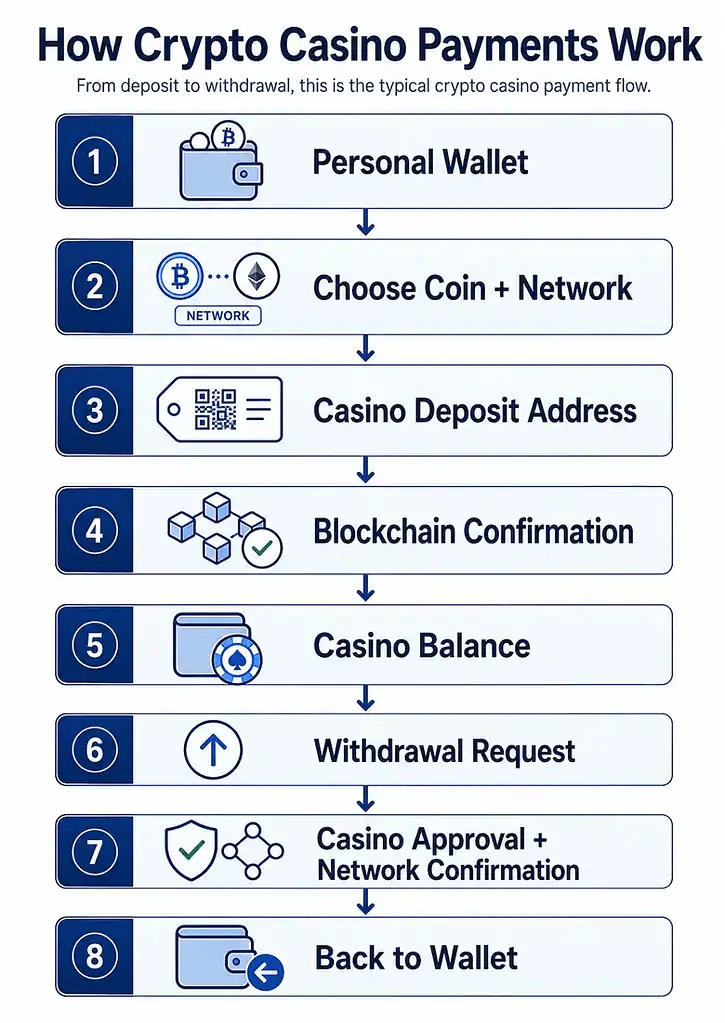
The deposit process at a crypto casino is more direct than at a fiat platform — there's no card processor, no Interac handshake, and no bank approval step in the middle. Once you know which network to use and have funds in an external wallet, a deposit takes under two minutes from start to credited balance. The most important decision is made before you send anything: confirm the network the casino supports for that coin, because sending funds on the wrong chain typically means they are gone permanently.
Deposit crypto in three steps — choose your coin, copy the casino's wallet address, and send from your external wallet. Funds appear after one blockchain confirmation, typically within two minutes on fast networks.
Sign up and go to the cashier
Create an account at a crypto casino — most only require an email and password. Navigate to the deposit section and select your preferred cryptocurrency — BTC, ETH, USDT, LTC, SOL, or others depending on what the platform supports.
Copy the casino's wallet address
The casino will generate a unique deposit address for that coin. Double‑check you're selecting the correct network (for example, USDT on TRC‑20, not ERC‑20) before sending — using the wrong network can result in permanent loss of funds.
Send funds from your personal wallet
Open your external crypto wallet, paste the casino's address, enter the amount (meeting the minimum, usually $10–$20 equivalent), and confirm the transaction. Your casino balance updates once the blockchain confirms the transfer — typically within seconds on Solana or TRC‑20, and within a minute or two for most other fast networks.
How to Withdraw Casino Winnings with Cryptocurrency
Crypto withdrawals are where these platforms most clearly outperform traditional casinos. The casino's side of the process is usually automated — once you submit a payout request, the system broadcasts the transaction to the blockchain within seconds rather than waiting for a finance team to review it during office hours. The main variable is which blockchain network you use.
Fast networks like Solana (SOL), TRC‑20 (USDT), and the Bitcoin Lightning Network can deliver funds to your wallet in under a minute. The Bitcoin Lightning Network requires the casino to support a Lightning node, so confirm this in the cashier before assuming it's available. Sending a withdrawal via Bitcoin mainnet or Ethereum mainnet during a congested period might take an hour or cost significantly more in fees. Always confirm which networks the casino supports before depositing — if a casino only accepts BTC mainnet, factor that into your expectations for both speed and cost.
Withdrawals are usually processed automatically by the casino — the main wait comes from blockchain confirmation. Choose a fast network like Solana, TRC‑20, or Lightning for near‑immediate delivery.
Go to the withdrawal section
In your casino account, open the cashier's withdrawal tab and select the cryptocurrency you want to receive. Use the same network you deposited with wherever possible — switching networks mid-session can trigger KYC verification.
Enter your personal wallet address
Paste the address of your external wallet — not the casino's deposit address. Carefully verify the first and last several characters before confirming. Sending to the wrong address results in permanent loss; there is no reversal process on the blockchain.
Confirm the amount and network fee
Enter the withdrawal amount, ensuring it meets the casino's minimum. The platform will display the network fee, which is deducted from your payout. Fast networks like Solana or TRC‑20 typically charge under $0.10; Bitcoin mainnet fees can be significantly higher depending on congestion.
Wait for casino approval and blockchain confirmation
Many crypto casinos approve withdrawals automatically within seconds. Once processed, the transaction is broadcast to the blockchain and funds arrive as soon as the required confirmations are reached — often under a minute for SOL or TRC‑20, up to an hour or more for BTC mainnet during busy periods.
Why Canadian Players Choose Crypto Casinos
The primary draws aren't ideological — they're speed and friction. A crypto withdrawal can land in your wallet before a traditional casino's finance team has even opened the request. For players who have waited three to five business days for an Interac e‑Transfer that then got reversed because of a name mismatch, that difference is decisive. Layered on top is privacy: with only an email address on file, gambling activity doesn't appear on bank statements, and you avoid the document uploads many fiat platforms require before you've placed a single bet.
The third quote above is worth taking seriously. Players using VPNs to access platforms from jurisdictions those casinos don't officially serve are in a genuinely vulnerable position if KYC is ever triggered — because the ID submitted must match a country the casino actually serves. This is a real risk, not a hypothetical one.
Quick Verdict
Crypto Casinos in Canada
Pros
- Withdrawals are processed almost instantly — no waiting for bank approval or business hours
- Privacy: many platforms only require an email to start, with no bank statements or government ID needed at entry
- High deposit and withdrawal limits that suit high rollers, with no bank caps
- Low transaction fees, especially on fast networks like Solana, TRC‑20, or Litecoin
- Provably fair games allow you to verify each bet's outcome independently
Cons
- Crypto price volatility can change the value of your bankroll between deposit and withdrawal
- Most crypto casinos operate offshore without Canadian provincial oversight — fewer consumer protections
- KYC may be triggered for large withdrawals, high‑volume play, or suspicious patterns — even on advertised no‑KYC platforms
- Requires basic knowledge of wallets, blockchain networks, and transaction fees — mistakes can be irreversible
- Not all game providers or bonuses are available at crypto casinos compared to licensed fiat platforms
How to Find a Casino That Accepts Crypto in Canada
Check for fast network support in the cashier. A casino might "accept Bitcoin," but if it only supports BTC mainnet, withdrawals can be slow and expensive. Look for platforms that also offer TRC‑20, Solana, Litecoin, or Lightning — and confirm Lightning support specifically, since it requires dedicated infrastructure rather than standard BTC support.
Don't assume no KYC means no verification at all. Many casinos allow small‑scale play without ID but will lock withdrawals above a threshold — often $5,000, and sometimes as low as $2,000 on newer platforms — until KYC is completed. Read the platform's terms before depositing large sums.
Verify licensing, but understand what it actually means. Most crypto casinos operate under offshore licences (Curaçao, Anjouan, Kahnawake). These provide a basic operational framework but don't offer the same consumer protections as an Ontario AGCO‑regulated site. The platform's track record and public payout history matter more than the licence logo in its footer.
Test the withdrawal pipeline with a small amount first. Deposit $20, play a few rounds, withdraw $10. If it's smooth, you can proceed with confidence. If it's not, you've only risked the minimum.
How Easy Is It to Deposit and Withdraw?
For anyone who has used a self‑custody wallet before, depositing is straightforward: copy the casino's address, paste it into your wallet, send. Withdrawals are equally simple, and because the casino's side is usually automated, funds are often broadcast to the blockchain within seconds. The learning curve exists entirely outside the casino — setting up a wallet, acquiring crypto from an exchange, and understanding network fees. Once past that initial step, the deposit‑and‑withdraw cycle is faster than any fiat payment method available to Canadian players.
What Documents Will You Need?
At a no‑KYC crypto casino, you may need nothing beyond an email address. That changes in three common scenarios:
High‑value withdrawals. Many platforms trigger KYC for single payouts above a threshold — often $5,000, sometimes as low as $2,000 on newer platforms.
Suspicious activity flags. Rapid deposit‑withdrawal cycling, VPN use that conflicts with your stated location, or deposits from flagged addresses can prompt a manual review, regardless of withdrawal size.
Mixed payment methods. Depositing with crypto and attempting to withdraw via a fiat method — or vice versa — almost always requires KYC to verify ownership of both payment instruments.
Always have a valid government ID and recent proof of address ready if you plan to play at high stakes. Even offshore casinos can freeze funds indefinitely if a verification request goes unsatisfied.
Is Crypto a Widely Used Casino Payment Method in Canada?
Usage is growing but remains a niche compared to Interac or credit cards. The barrier is the onboarding step of acquiring cryptocurrency. For players who already hold BTC, ETH, or USDT, crypto casinos are often the preferred platform. For the average Canadian banking with a major institution who has never used a wallet app, the friction of that initial setup means crypto casinos remain a smaller — though dedicated — segment of the market.
Crypto Casinos vs. Traditional Online Casinos in Canada
| Crypto Casinos | Traditional Fiat Casinos | |
|---|---|---|
| Payment method | BTC, ETH, USDT, LTC, SOL and others | Interac, credit/debit cards, bank transfer |
| Deposit speed | Near‑instant after blockchain confirmation | Instant to a few hours |
| Withdrawal approval | Often automated (seconds to minutes) | Manual review (1–3 days typical) |
| Payout delivery | Minutes to under an hour (network‑dependent) | 1–5 business days after approval |
| Privacy / data shared | Email only at entry; ID only if KYC triggered | Full KYC mandatory before playing or withdrawing |
| KYC requirements | Optional or triggered on large withdrawals | Mandatory full verification upfront |
| Fees | Network fees only (low on fast chains) | Bank or processor fees may apply |
| Access | Global, offshore platforms available across Canada | Restricted to provincially licensed or approved platforms |
How Safe Is It to Use Crypto at Online Casinos?
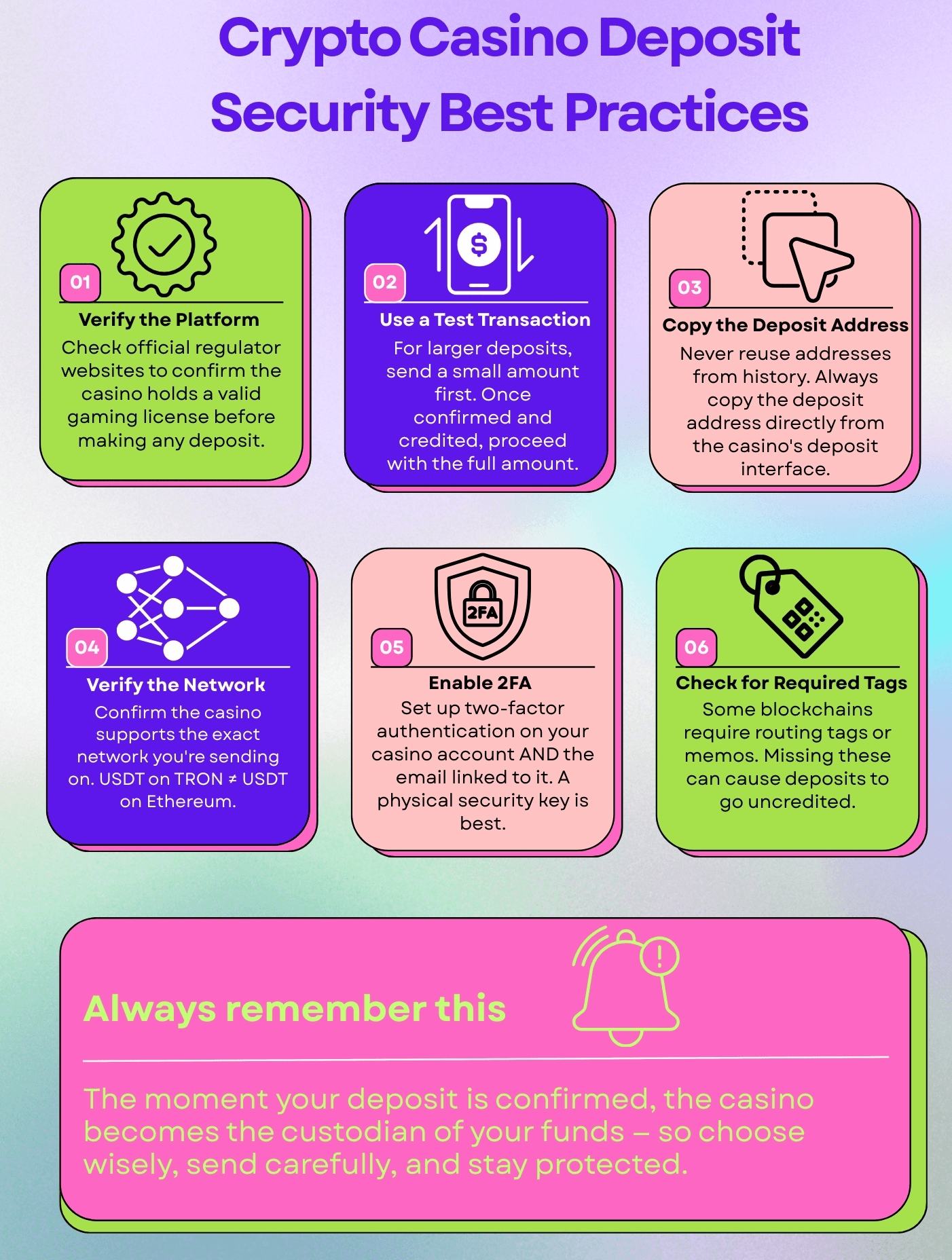
The security model is inverted compared to traditional casinos. Your funds aren't protected by deposit insurance, chargeback rights, or a provincial regulator — they exist in a blockchain wallet controlled by a private key. If the casino is hacked or goes rogue, there is no central authority to appeal to. The flip side is that you never hand over enough personal data for identity theft to be a serious risk, and the immutable nature of blockchain transactions means a casino can't retroactively alter a payout once it's been broadcast.
Practical safety steps are non‑negotiable: enable two‑factor authentication (2FA) on both your casino account and your external wallet, verify every wallet address character by character, and never keep more funds on a casino platform than you're willing to lose. For large balances, withdraw to a hardware wallet rather than leaving them in the casino's custody.
What Fees Apply When Using Crypto for Online Casino Play?
Crypto casinos typically don't charge processing fees beyond the blockchain's own network fee, which goes to miners or validators, not the casino. Those network fees vary significantly and can fluctuate over time — figures below reflect typical conditions as of publication.
- Solana, TRC‑20, Litecoin: Usually under $0.01 to $0.10 per transaction.
- Bitcoin mainnet: Can range from $1 to $30 or more depending on network congestion.
- Ethereum mainnet (ERC‑20): Gas fees can spike well above $20 during periods of high demand — for casino-sized transactions this can represent a meaningful percentage of the total, and ERC‑20 should generally be avoided in favour of faster, cheaper alternatives where the casino supports them.
Some casinos build a small margin into their exchange rate when you buy crypto directly on the platform using a credit card or Interac. Depositing from an external wallet avoids this entirely. Always check the cashier for any "processing fee" line item — reputable crypto casinos are transparent about deductions before you confirm a transaction.
Key Takeaways
- Crypto casinos bypass traditional banking rails — deposits and withdrawals happen directly between your wallet and the casino, with no involvement from banks, Interac, or card processors.
- Withdrawal speed depends on both the casino's internal processing (often instant) and the blockchain network you choose — Solana, TRC‑20, and Lightning settle in seconds; Bitcoin mainnet can take 30–60 minutes or longer during congestion.
- While many crypto casinos advertise 'No KYC,' verification is frequently triggered by large withdrawals (often above $5,000), high‑volume play, or attempts to cash out via a different method than the one used to deposit.
- Stablecoins like USDT and USDC on fast networks remove the risk of crypto price swings during a session, while still offering the speed and low fees of blockchain payments.
- Because most crypto casinos operate outside Canada's provincial licensing, players should test small withdrawals, enable 2FA, and research a platform's reputation before committing larger funds.
Frequently Asked Questions
Can I withdraw winnings in crypto? Yes — it's the default payout method at crypto casinos. Always use the same network you deposited with unless the cashier explicitly confirms cross‑network withdrawals are supported. Switching networks without confirmation can result in lost funds.
Do I need to verify my identity? Not always. Many platforms operate without KYC for small to medium accounts, but verification is typically triggered for withdrawals above a certain threshold — often $5,000, sometimes lower — or for unusual activity patterns. Having a government ID and proof of address ready avoids delays if this is triggered.
Will using crypto stop me from claiming a bonus? Usually not — crypto deposits are eligible for most bonuses. However, some bonuses are specifically designed for fiat deposits, so always read the promotion terms before depositing under a specific offer.
What happens if I send crypto to the wrong network or address? In most cases, the funds are permanently lost. Casinos cannot reverse blockchain transactions. Always double‑check the network selected and the full wallet address before confirming any send.
Does Bitcoin Lightning Network work at all crypto casinos? No. Lightning requires a casino to operate a dedicated Lightning node — it's not automatically available just because a platform accepts Bitcoin. Confirm Lightning support specifically in the cashier before assuming it applies to your withdrawal.
Are crypto winnings taxable in Canada? The Canada Revenue Agency does not tax recreational gambling winnings, but converting crypto back to CAD may constitute a taxable disposition for capital gains purposes if the coin's value has changed since you acquired it. The CRA's guidance on cryptocurrency is the authoritative reference — see the authority resources below.
Related payment methods
People also search

Good to know
Official & community sources
Worth reading if you want the provider's own rules and how other Irish players discuss these methods — our guide above covers what matters for day-to-day deposits and withdrawals.
- Canada Revenue Agency — Gambling Income and CryptoCanada Revenue Agency
Official guidance on when gambling winnings are taxable in Canada and how converting crypto gains may trigger capital gains tax obligations.
Licensing authority for interactive gaming from the Mohawk Territory of Kahnawà:ke — verify permit holders, player protection standards, and dispute resolution for KGC-licensed crypto casinos.
- Problem Gambling Helpline — CanadaCanadian Centre on Substance Use and Addiction
National helpline (1‑800‑522‑4700) providing 24/7 support and referrals for problem gambling across all provinces and territories.
- ConnexOntario — Gambling SupportConnexOntario
Ontario-specific mental health and addiction helpline (1‑866‑531‑2600) with referrals to provincial treatment services for gambling harm.
National organisation offering tools, self‑assessment, and links to provincial support services for problem gambling.
- Bitcoin.org — Wallets and SecurityBitcoin.org
Educational resource on choosing a secure wallet and understanding transaction fees — essential for casino players new to crypto.
Play Within Your Limits
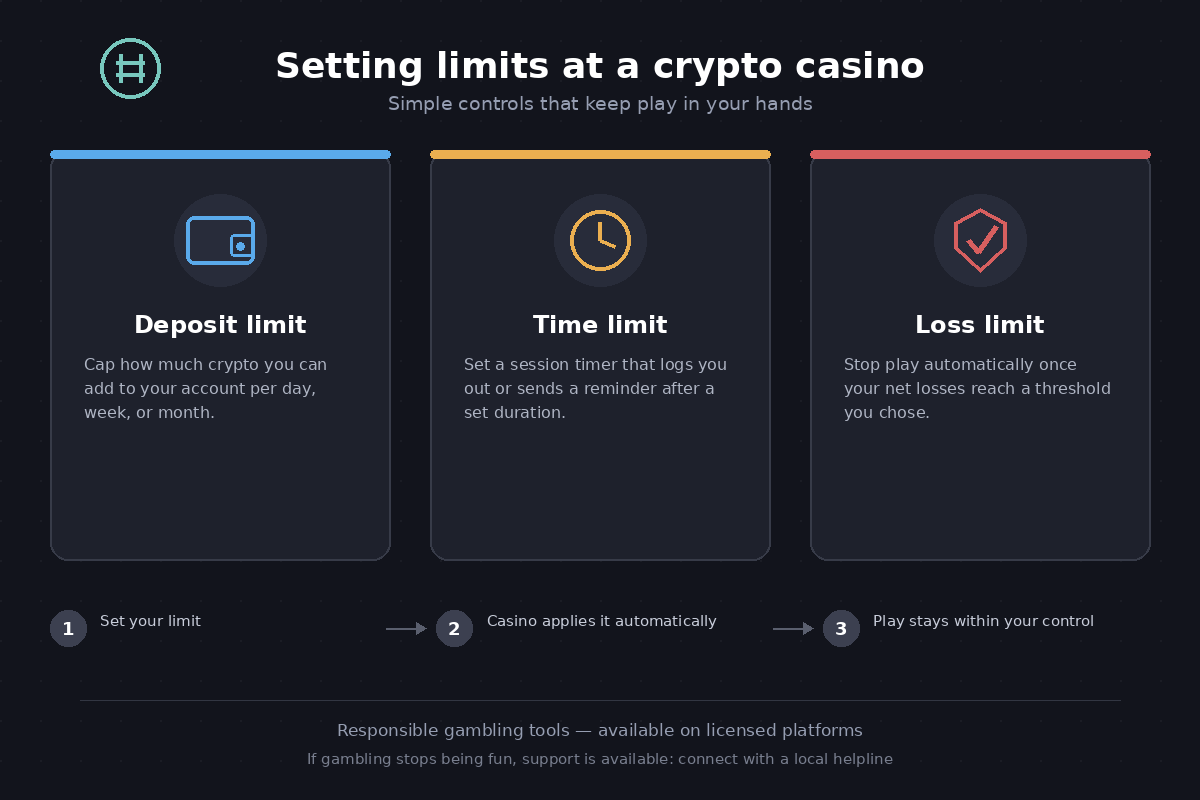
The same qualities that make crypto casinos fast — instant deposits, automated withdrawals — can also make them more dangerous for players who struggle with impulse control. A deposit takes under a minute, and a losing session can be reloaded almost immediately with no bank‑side friction. The best crypto platforms now offer the full suite of responsible gambling tools: deposit limits, loss limits, session timers, and self‑exclusion. Using them is not a sign of weakness; it's an acknowledgement that tools designed to remove friction also remove the natural pauses that used to act as circuit‑breakers.
Support is available across Canada regardless of which province you're in:
- Problem Gambling Helpline — National, 24/7: 1‑800‑522‑4700 or problemgambling.ca
- ConnexOntario — Ontario-specific addiction and mental health referrals: 1‑866‑531‑2600 or connexontario.ca
- Responsible Gambling Council — Tools, self‑assessment, and provincial resources: responsiblegambling.org
Bonus Alerts
Get Exclusive Bonus Alerts First
Pick the offer types you care about — we'll email you when new promo codes drop, exclusive deals go live, and editors flag limited-time bonuses for Irish players.
18+ only · Unsubscribe anytime · No spam