Regulation
Licensing & Regulation for Casinos in South Africa
How online casino licensing works for South African players — provincial boards, offshore MGA/Curacao operators, FICA checks, and what to verify first.
South Africa regulates gambling through provincial boards and national oversight. Many online casinos SA players use are offshore-licensed — here is how to read that landscape without legal panic or false certainty.
Boards license land-based casinos, LPMs, and betting activities in each province.
International sites often show Malta, Curacao, or similar seals — verify the seal.
Expect ID and proof of address before larger withdrawals.
Responsible gambling help: 0800 006 008
South Africans play online casinos every day. Some of those products sit under local betting or casino licences. Many popular international casino brands do not — they hold licences abroad and accept SA players with ZAR cashiers and Instant EFT rails.
This page explains that split in plain language so you can check a site before you fund it.
How SA regulation is organised
Gambling policy sits nationally with bodies such as the National Gambling Board, while day-to-day licensing of casinos, limited payout machines, and betting is largely provincial. Boards you will see named in SA-licensed contexts include (non-exhaustive):
- Western Cape Gambling and Racing Board (WCGRB)
- Gauteng Gambling Board (GGB)
- KwaZulu-Natal Gaming and Betting Board
- Eastern Cape Gambling and Betting Board
- Free State Gambling, Liquor and Tourism Authority
- Limpopo Gambling Board
- Mpumalanga Economic Regulator (MER)
- North West Gambling Board
- Northern Cape Gambling Board
A licence always states which activities it covers. A sports-betting licence is not automatically an open-ended online slots licence. Provincial boards publish registers of licensed operators on their websites, and these are the most authoritative source for verifying whether a local operator is genuinely licensed.
The National Gambling Act of 2004 and subsequent amendments set the national framework, but enforcement and licensing power rests with provincial regulators. This means there is no single national online casino licence in South Africa — what exists is a patchwork of provincial approvals for specific gambling activities, mostly land-based and sports betting.
National Gambling Board role
The NGB coordinates policy, monitors compliance across provinces, and maintains the national gambling database. It does not issue casino licences directly — that power sits with provincial boards. The NGB also tracks illegal gambling operations and publishes industry statistics, which makes it a useful reference for understanding the broader landscape even if it cannot resolve individual player disputes with offshore operators.
SA-licensed products vs offshore casinos
Locally licensed operators typically require SA contact details, FICA verification, and rand banking. They are tied into South African compliance expectations. If you play at a provincially licensed sports book or land-based casino, your consumer protections are clear: you can escalate complaints to the relevant provincial board, and the operator is subject to South African law.
Offshore-licensed casinos (often MGA, Gibraltar, Alderney, or Curacao) market internationally. They are not "SA online casino licences." Player protection runs through that foreign regulator — complaint paths, advertising rules, and bonus disclosure standards vary by authority.
This creates a grey zone. The National Gambling Act prohibits interactive gambling services offered from within South Africa, but it does not clearly criminalise individual players who access offshore sites. In practice, many South African players use offshore-licensed casinos daily without legal consequence. The risk is not prosecution — it is weaker consumer protection and the possibility that a dispute must be resolved through a foreign regulator with different standards and slower response times.
What the grey zone means for your money
If an offshore casino refuses a payout, you cannot take them to a South African court under local gambling law. Your recourse is the licensing authority — and some authorities are more responsive than others. This is why verifying the licence before depositing matters more than the licence logo on the homepage.
Licence authorities worth recognising
Not all offshore licences carry the same weight. Here is how to read the common ones:
Malta Gaming Authority (MGA)
The MGA is widely considered the gold standard for offshore casino licensing. It requires segregation of player funds, regular auditing, and maintains a public licence register where you can verify any MGA-licensed operator. Complaints can be escalated through the MGA's Player Support Unit. If a casino shows an MGA seal, it is worth the time to verify it.
UK Gambling Commission (UKGC) style
Some operators hold UKGC licences but do not accept South African players due to UK market restrictions. You may see UKGC seals on brands that share ownership with MGA-licensed sites. The UKGC sets strict standards on advertising, game fairness, and responsible gambling, but its direct protection does not extend to SA players unless the specific site holds a UK licence and accepts SA registrations.
Gibraltar and Alderney
These are smaller but reputable jurisdictions with solid regulatory track records. Gibraltar-licensed operators typically serve European markets, while Alderney (part of the Channel Islands) licenses a smaller number of high-quality operators. Both maintain public registers.
Curacao eGaming
Curacao licences are common among casinos that accept South African players, but the quality varies enormously. Curacao has historically operated a master licence system where sub-licences are issued with less direct oversight. A Curacao seal means a licence exists; it does not automatically mean strong player protection. Some Curacao-licensed operators pay reliably and run fair games; others do not. The key is to verify the specific operator's track record through player forums, withdrawal reports, and how transparently they display licence details.
Kahnawake Gaming Commission
Based in Canada, Kahnawake licences some poker rooms and casinos that accept international players. It is less common in the SA market but worth recognising if you encounter it.
How to verify a licence
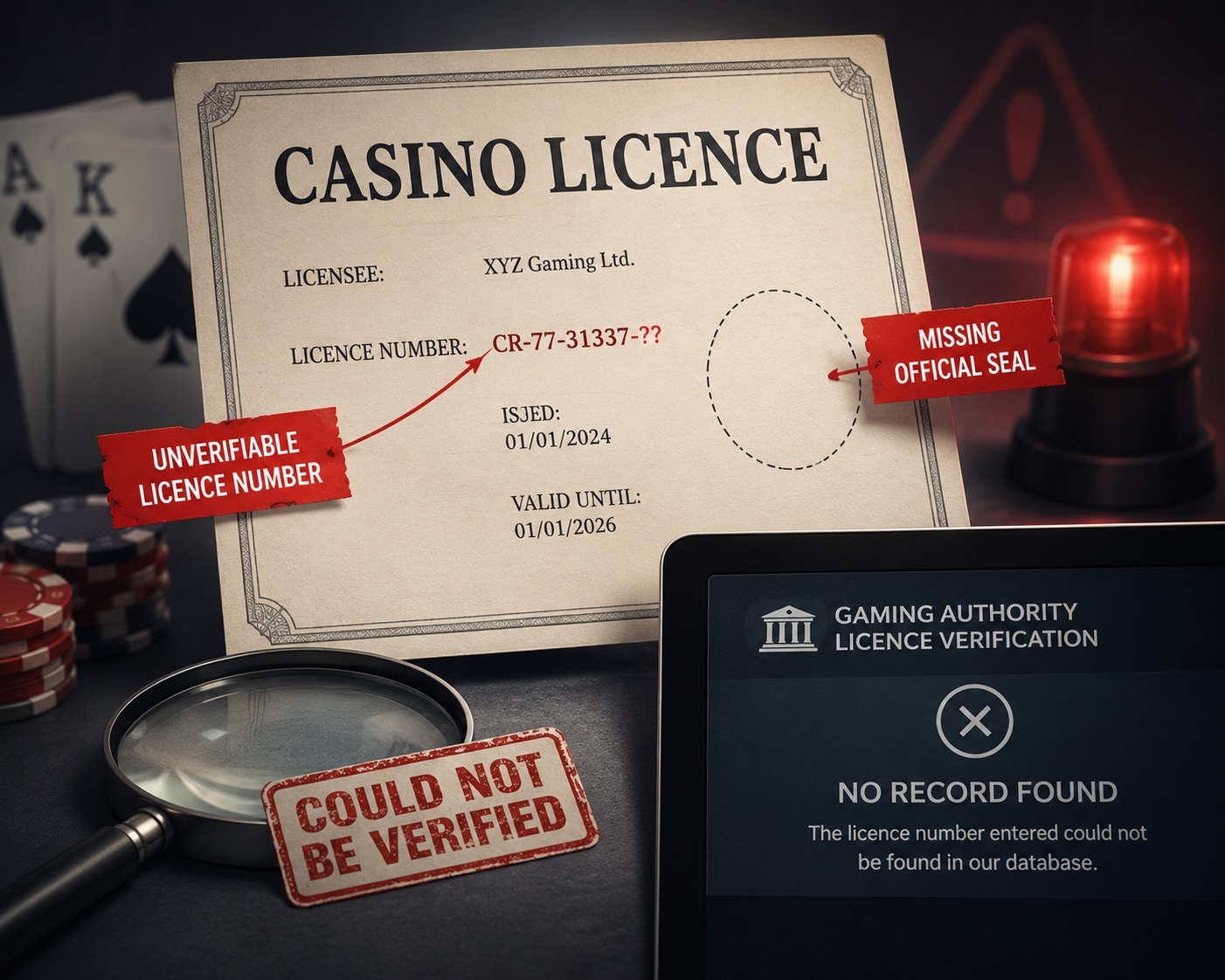
The homepage seal is not enough. Follow this walkthrough before you deposit:
- Scroll to the footer of the casino site and look for a licence name and number
- Click the seal or licence text — it should resolve to a live register entry on the regulator's official website
- If the link is dead, the number is missing, or the register shows a different operator name, treat it as a red flag
- Cross-check the operator name on the register with the brand name you are playing at — some casinos operate under white-label agreements where the licence holder differs from the brand
This check should take under two minutes. If it takes longer because the site buries the licence information, that opacity is itself a warning sign.
FICA / KYC: what players must prepare
FICA (Financial Intelligence Centre Act) and KYC (Know Your Customer) requirements are not optional obstacles — they are legal requirements for casinos to verify identity before processing withdrawals. South African players should prepare:
- Valid ID: South African ID book, smart ID card, or passport
- Proof of address: Utility bill, bank statement, or municipal account dated within the last three months
- Proof of payment method: Screenshot or photo of the card or e-wallet used to deposit, sometimes with specific digits obscured for security
Complete FICA as soon as you register, not when you request your first withdrawal. Delays at withdrawal time are almost always because players wait until they want their money to submit documents. Most reputable casinos process verification within 24–72 hours, but this can stretch to a week during busy periods or if documents are unclear.
Why casinos are strict about FICA
Anti-money-laundering regulations require casinos to verify that funds are not proceeds of crime and that the person withdrawing is the same person who deposited. This protects both the operator and legitimate players. A casino that skips FICA is a casino that regulators will shut down — so resistance to verification is a sign of a poorly run site, not a scam.
Payment blocks vs legality
South African banks routinely block gambling transactions. This is not proof that a casino is unlicensed or illegal — it is banking risk policy. Banks apply merchant category code blocks and 3D Secure friction to gambling transactions under the National Gambling Act and their own compliance frameworks.
If your card deposit fails, it usually means:
- Your bank has a gambling transaction block
- The merchant code triggered a fraud alert
- 3D Secure authentication failed
It rarely means the casino is fake. The solution is to switch payment rails. Instant EFT and Ozow bypass card networks and clear directly from your bank account. See our Visa & Mastercard page for more on why cards fail and how to work around it.
Red flags
Watch for these warning signs before you deposit:
- No licence details, or a seal that does not resolve to a live register entry
- Only crypto deposits with no clear withdrawal path or fiat conversion
- Support that cannot explain KYC requirements or payout timelines in plain language
- Bonus terms that hide the wagering base, max bet, or cashout caps behind vague language
- Ownership opacity — no clear company name, registration number, or physical address
- Pressure to deposit before you have read terms or verified the licence
- Withdrawal limits that trap large balances behind impossible playthrough requirements
Player checklist before first deposit
- Licence verified: Name and number checked on the regulator's official register
- Payment method ready: Cashier shows a SA-friendly method you already use and understand (payments hub)
- Bonus terms read: Wagering calculated in rand, max bet and expiry noted
- FICA documents prepared: ID and proof of address ready for upload
- Limits set: Deposit and loss limits configured on the account (responsible gambling)
- Support tested: Sent a question and received a coherent response within a reasonable timeframe
Frequently asked questions
Is online casino play illegal for South African residents?
Local law focuses on who may offer gambling, not who may access it. The National Gambling Act prohibits interactive gambling services operated from within South Africa, but offshore operators fall outside this scope. Individual players are not typically prosecuted for using licensed international sites. This is not legal advice — when in doubt, consult a qualified legal adviser.
Does a Curacao licence mean the site is safe?
It means a licence exists. Curacao's regulatory framework is less stringent than Malta or the UK, and enforcement varies. A Curacao seal does not guarantee payout quality or fair dispute resolution. Check ownership transparency, game providers, and real player withdrawal evidence before trusting the seal alone.
Why do I need FICA verification?
South Africa's Financial Intelligence Centre Act requires casinos to verify customer identity to prevent money laundering and fraud. This is standard across all regulated gambling and banking. Completing FICA early prevents withdrawal delays.
Can the NGB help with a dispute against an offshore casino?
No. The National Gambling Board oversees South African gambling policy and provincial compliance. It has no jurisdiction over offshore operators licensed in Malta, Curacao, or elsewhere. Disputes with offshore casinos must be directed to the licensing authority or, in some cases, alternative dispute resolution services linked to the regulator.
What is the difference between provincial and national gambling regulation?
National policy is set through the National Gambling Act and coordinated by the NGB. Actual licensing, enforcement, and complaint handling for land-based casinos and betting happen at provincial level through boards like the WCGRB or GGB. There is no single national online casino licence — each province manages its own licensed operators.
Why does my bank block deposits to licensed casinos?
Banks apply gambling transaction blocks as part of risk management and compliance with the National Gambling Act. A blocked card deposit does not mean the casino is unlicensed — it means your bank restricts gambling merchant codes. Instant EFT is the standard workaround.
Can I trust a casino that does not show its licence number?
No. Every legitimate operator displays its licence details prominently, usually in the footer. If the licence number is missing, hidden, or the seal does not link to a live register, treat it as a major red flag and do not deposit.
How long should FICA verification take?
Most reputable casinos process FICA within 24–72 hours of receiving clear, valid documents. Delays usually happen when documents are blurry, expired, or do not match the registration details. Submit everything at registration to avoid waiting when you want to withdraw.
Key Takeaways
- Provincial licences cover SA-regulated products; most big online casino brands SA players use are offshore.
- Offshore play sits in a grey area for operators — players are not typically prosecuted for using reputable sites, but consumer protection differs.
- Always verify a licence number on the regulator's site before depositing.
- FICA/KYC delays are normal — complete them early.
- Bank payment blocks do not equal a 'licence check' — they are banking policy.
Good to know
Official & community sources
Primary references for South African gambling oversight and common offshore licensing.
National gambling oversight and industry information.
Example provincial regulator — others exist per province.
Widely recognised offshore licensing authority.
- NRGPNRGP
Player support and safer-gambling resources.
Bonus Alerts
Get Exclusive Bonus Alerts First
Pick the offer types you care about — we'll email you when new promo codes drop, exclusive deals go live, and editors flag limited-time bonuses for Irish players.
18+ only · Unsubscribe anytime · No spam