Safer Play
Responsible Gambling Resources in South Africa
NRGP helpline, deposit and loss limits, self-exclusion, bank gambling blocks, and practical safer-play habits for South African casino players.
Tools and contacts that keep gambling as entertainment — NRGP support, account limits, self-exclusion, and bank-level blocks.
National Responsible Gambling Programme — free and confidential
Use for non-urgent support pathways and information requests
Operator tools plus NRGP guidance for broader support
Underage gambling is illegal and harmful
Responsible gambling means keeping money, time, and mood under your control. It is not about stopping play entirely — it is about ensuring that play remains a form of entertainment with boundaries you set and keep.
For South African players, the landscape creates specific risks. Instant EFT and Ozow make funding effortless. Offshore casinos operate in a grey zone where consumer protections are weaker. Bonuses with opaque terms can encourage larger deposits than intended. And credit facilities like Mobicred turn gambling spend into debt.
This page is a practical guide to the tools, contacts, and habits that keep play within your limits.
What responsible gambling means
At its core, responsible gambling is pre-commitment. You decide your budget, your time, and your exit conditions before you open the cashier or load a game. The decision happens when you are calm, not when you are chasing a loss or riding a win streak.
It also means understanding that gambling products are designed to keep you playing. Near-misses on slots, rapid spin cycles, and bonus triggers that feel like rewards are all engineered engagement mechanics. None of this is malicious — it is how the industry works — but it means your natural impulse to continue will often conflict with your pre-set limits. Tools exist precisely because willpower alone is unreliable.
Golden rules
These five rules are non-negotiable. Break any of them, and you should pause play immediately:
- Only stake money you can afford to lose — never gamble with rent, groceries, or emergency savings
- Decide the session length in advance — set a timer and stop when it rings, regardless of whether you are up or down
- Never chase losses — depositing more to recover a losing session almost always deepens the loss
- Do not borrow to gamble — this includes credit cards, personal loans, and credit facilities like Mobicred
- Take breaks after wins as well as losses — a win streak is as dangerous as a losing one for clouding judgment
These rules sound simple. They are simple. The difficulty is applying them when emotion is high, which is why the tools below matter.
Casino tools: deposit, loss, wager, and session limits
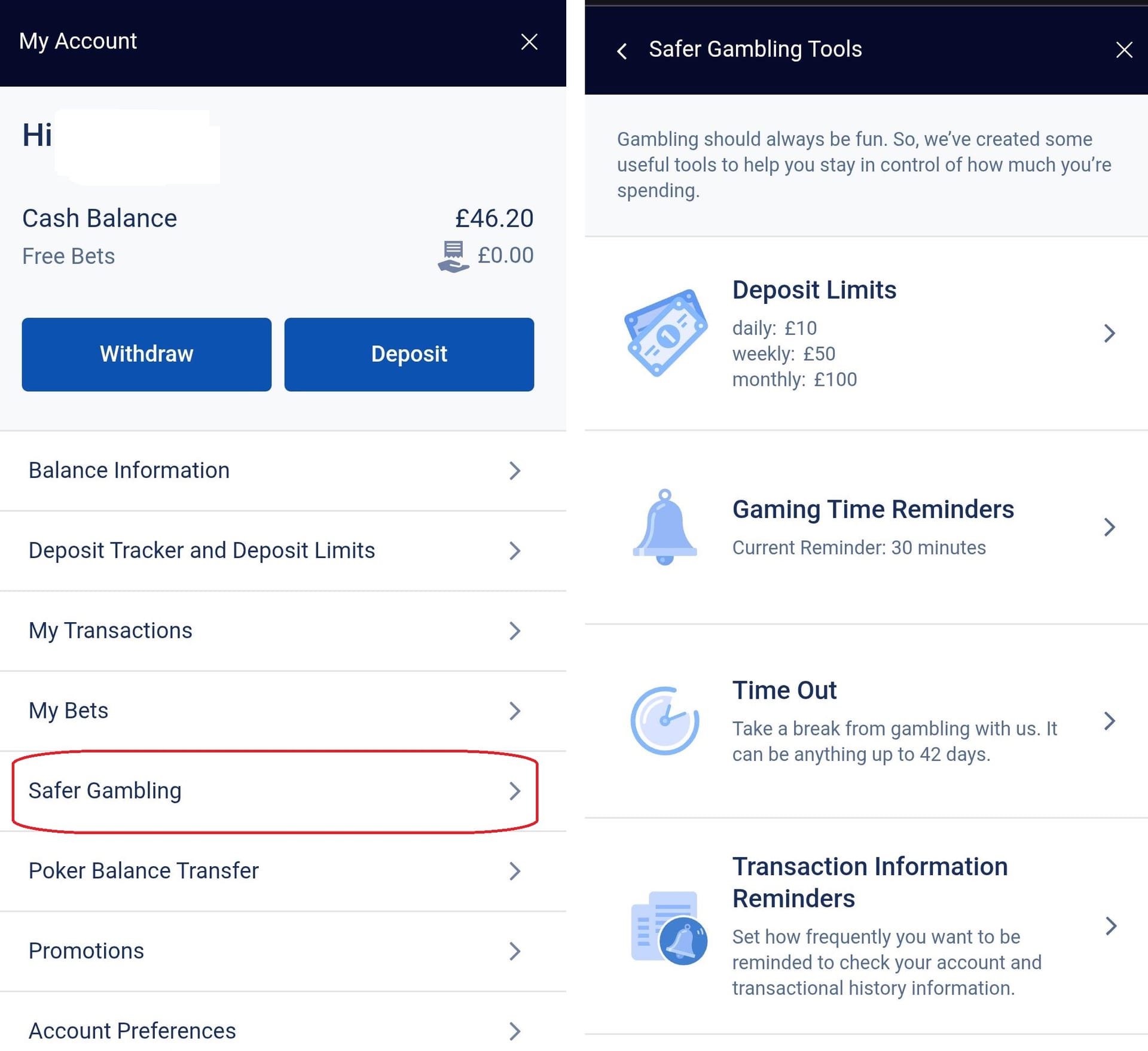
Most reputable casinos offer four types of account limits. Understanding each one helps you build a layered defence:
Deposit limits
A deposit limit caps how much money you can add to your account over a set period — daily, weekly, or monthly. This is the most direct control on your bankroll. Set it low enough that reaching the cap feels like a natural pause, not a frustration to circumvent.
How to use it effectively: Set your deposit limit before your first deposit, not after. Lower it when things are going well. Reputable casinos enforce a cooling-off period — often 24 hours or longer — before you can raise a deposit limit. This delay is a feature, not a bug. It prevents impulse decisions to increase your budget mid-session.
Loss limits
A loss limit restricts how much you can lose over a period, regardless of how much you deposit. If you deposit R500, win R300, then lose R800, your net loss is R500. A loss limit of R300 would lock your account once that threshold is hit, even if you still have deposited funds available.
This is useful because it protects winning sessions from evaporating. Many players set deposit limits but forget that winnings can be lost just as easily as deposits.
Wager limits
A wager limit controls how much you can bet in total over a period, independent of wins and losses. If you set a R1,000 weekly wager limit, you cannot place more than R1,000 in bets that week, even if you are winning.
This is particularly valuable for players who use strategies like Martingale or who increase bet sizes during sessions. It forces a hard stop on total exposure.
Session limits
A session limit automatically logs you out after a set amount of active play time — typically 30 minutes, 1 hour, or a custom duration. This prevents the "just one more spin" trap that extends sessions far beyond what you intended.
Best practice: Set a session limit shorter than you think you need. If you planned to play for an hour, set the limit at 45 minutes. The forced break gives you time to assess whether you genuinely want to continue or are simply responding to momentum.
Reality checks
Some casinos offer pop-up notifications that appear after a set interval — every 15 minutes, 30 minutes, or hour — showing your net result for the session. These are less forceful than session limits but serve as a useful mirror. If the reality check shows you are down R800 after 20 minutes, it is a signal to stop and reassess.
Self-exclusion: operator-level and beyond
Self-exclusion is the nuclear option. It blocks access to your casino account for a fixed period — typically 6 months, 1 year, or permanently. During self-exclusion, the operator must:
- Prevent you from logging in
- Stop sending marketing communications
- Refuse any new deposits or bets
- Process any pending withdrawals of your balance
Operator self-exclusion
Most casinos offer self-exclusion through their responsible gambling settings. Before you activate it, read the duration carefully. Some operators allow early revocation after a cooling-off period; others enforce the full term with no exceptions. Know which policy applies before you commit.
Multi-operator exclusion
South Africa does not yet have a unified national self-exclusion register like the UK's GAMSTOP. This means self-excluding from one casino does not block you from registering at another. If you need broader protection, the NRGP can guide you toward additional measures, including:
- Counselling and support group referrals
- Bank-level gambling blocks
- Site and ad blockers across your devices
- Family support and financial counselling
When to self-exclude
Do not wait for a crisis. Self-exclude if you:
- Find yourself regularly exceeding your deposit or loss limits
- Hide your gambling from family or friends
- Feel irritable or anxious when you try to stop
- Have borrowed money to gamble
- Are spending more time or money than you intended
Self-exclusion is not weakness. It is a tool for regaining control, and using it early prevents deeper problems.
Bank and card gambling blocks
South African banks and some financial apps can restrict gambling merchant categories. This creates friction — and that friction is protective.
How bank blocks work
Banks use merchant category codes (MCCs) to identify gambling transactions. When a block is active, deposits to casinos via card are declined at the bank level, before they reach the operator. This is why Visa and Mastercard deposits often fail even at fully licensed casinos — the block is not a licence check, it is a risk management decision by your bank.
Which banks offer blocks
Major South African banks including FNB, Standard Bank, Absa, Nedbank, and Capitec have introduced or are piloting gambling transaction controls. These may be:
- Hard blocks that decline all gambling MCCs
- Soft limits that require additional authentication
- Spending caps on gambling categories specifically
Contact your bank to ask what options are available. Some blocks are activated through online banking; others require a branch visit or phone call.
Instant EFT and bank blocks
Instant EFT bypasses card networks and connects directly to your bank account. This means a card gambling block will not stop an Instant EFT deposit. If you need to block gambling spend entirely, you must request a broader account restriction or close the specific payment method.
Ad and site blockers
Blocking gambling advertisements and websites on your devices removes a common relapse trigger. This is especially important during self-exclusion, when marketing emails and retargeting ads can undermine your commitment.
Practical steps
- Browser extensions: Tools like GamBlock, BetBlocker, or browser-level site blocking can restrict access to gambling domains
- DNS-level blocking: Configure your router or device DNS to block gambling categories
- Social media ad preferences: Turn off gambling-related ad categories on Facebook, Instagram, and Google
- Email filters: Create rules that automatically delete or filter casino marketing emails
Ad blockers are not a substitute for self-exclusion or counselling, but they reduce the ambient pressure to return. Pair them with other tools, not instead of them.
Warning signs checklist
Gambling problems rarely announce themselves. They develop gradually, often masked by the normalisation of gambling in South African social and sporting culture. Watch for these signs in yourself or someone close to you:
- Hiding play from family, partners, or friends — lying about time spent or money lost
- Borrowing to deposit — using credit cards, loans, or Mobicred to fund gambling
- Irritability when trying to stop — feeling restless, anxious, or angry when you cannot play
- Neglecting responsibilities — work, relationships, or health suffering because of gambling time or preoccupation
- "Just one more deposit" — repeatedly breaking self-imposed limits with rationalisations
- Gambling to escape — using play to avoid stress, depression, or other problems
- Chasing losses — increasing bet sizes or deposits to recover previous losses
- Preoccupation — constantly thinking about gambling, planning the next session, or reliving past wins
If two or more of these apply to you, pause play and contact the NRGP. If they apply to someone you know, approach the conversation with concern rather than accusation. The NRGP offers resources for family members as well as players.
Underage gambling
Gambling is strictly for adults aged 18 and over in South Africa. Underage gambling is illegal and harmful for several reasons:
- Brain development: Decision-making and risk-assessment areas of the brain continue developing into the mid-20s. Young people are more vulnerable to impulsive gambling behaviour.
- Normalisation: Early exposure to gambling products increases the likelihood of problematic play in adulthood.
- Financial harm: Young people lack independent income and may steal, borrow, or use family funds to gamble.
Protecting minors
- Keep casino passwords private and do not save them on shared devices
- Use parental controls on computers, tablets, and phones
- Monitor bank statements and payment apps for unexpected gambling transactions
- Talk to young people about gambling risks, especially around sports betting advertising
- Never let minors access your casino account, even "just to look"
If you suspect underage gambling, contact the NRGP for guidance. Provincial gambling boards also investigate underage access complaints against licensed operators.
Credit risk: the Mobicred warning
Mobicred is a credit facility that allows online purchases — including casino deposits — to be paid off over time. For gambling, this is dangerous for two reasons:
- It turns gambling losses into debt — a losing session does not just cost your bank balance; it creates a liability you must repay with interest
- It removes the immediate pain of loss — credit delays the financial consequence, making it easier to deposit more than you would with cash
Our position is simple: do not use Mobicred or any credit product to fund gambling. If you cannot afford to deposit from your current account balance, you cannot afford to gamble. The convenience of credit-funded play is not worth the debt spiral it can trigger.
How Instant EFT speed changes risk
Instant EFT has transformed South African casino deposits. Where card deposits might fail, bounce, or require 3D Secure authentication, Instant EFT clears in seconds directly from your bank account.
This speed is a double-edged sword. On one hand, it solves the practical problem of declined deposits. On the other hand, it removes every natural pause point in the funding process:
- No card number to type
- No 3D Secure redirect to slow you down
- No "transaction pending" period to reconsider
- Just a bank login, an approval, and immediate playable funds
For players with solid limits, this is convenience. For players without limits, it is acceleration. The NRGP has noted that faster payment rails correlate with higher rates of impulsive depositing. The solution is not to avoid Instant EFT — it is the most reliable deposit method for SA players — but to build your defences before you use it.
Getting help
If gambling is no longer fun, or if you recognise warning signs in yourself or someone you care about, help is available and free.
| Resource | Contact | When to use |
|---|---|---|
| NRGP helpline | 0800 006 008 | Immediate support, crisis intervention, or initial assessment — available 24/7 |
| NRGP email | helpline@responsiblegambling.org.za | Non-urgent enquiries, information requests, or follow-up support |
| NRGP website | responsiblegambling.org.za | Self-assessment tools, counselling referrals, and educational resources |
| Your bank | Branch or phone banking | Enabling gambling transaction blocks or account restrictions |
| Casino support | Operator live chat or email | Setting account limits, requesting self-exclusion, or clarifying responsible gambling tools |
If you are in immediate physical danger or experiencing severe mental health crisis, contact emergency services (10111) or go to your nearest hospital.
FAQ
Will setting deposit limits stop me from having fun?
No. Deposit limits keep you within a budget you already decided was affordable. They prevent the "one more deposit" impulse that turns entertainment into financial stress. You can still play fully within your limit.
Can I revoke self-exclusion early if I change my mind?
Usually not. Most operators enforce self-exclusion periods strictly, with no early revocation. Some allow a cooling-off period before activation, but once active, the block is intended to be absolute. Treat self-exclusion as a binding commitment, not a temporary pause.
Are welcome bonuses compatible with safer play?
Only if you already set a budget. A 100% match offer is not a reason to deposit more than you planned. See our welcome bonus guide for how to evaluate bonus terms without increasing your risk.
Why does my bank block gambling deposits even at licensed casinos?
Banks apply gambling transaction blocks as part of risk management and compliance with the National Gambling Act. A blocked card deposit does not mean the casino is unlicensed — it means your bank restricts gambling merchant codes. See our licensing page for more on payment blocks vs legality.
Can I use Instant EFT responsibly?
Yes, but it requires pre-commitment. Set your casino account limits before linking your bank. The speed of Instant EFT is convenient for planned deposits but dangerous for impulsive ones. The tool is neutral; your preparation determines the outcome.
What is the difference between a loss limit and a deposit limit?
A deposit limit caps how much money you can add to your account. A loss limit caps how much you can lose, regardless of deposits or wins. If you deposit R500, win R400, then lose R900, your net loss is R500 — but a loss limit of R300 would have locked your account before that point. Both tools are useful; use them together.
Should I tell my family if I am struggling with gambling?
Yes, if it is safe to do so. Secrecy sustains problem gambling. Family support, combined with professional help from the NRGP, is one of the most effective recovery pathways. The NRGP also offers resources specifically for family members who want to help a loved one.
Key Takeaways
- Set a rand budget and a time limit before you open the cashier.
- Use deposit, loss, and session limits on the casino account.
- Self-exclusion is a hard stop — use it early if control is slipping.
- Bank gambling blocks add a second layer, especially with Instant EFT and cards.
- NRGP: 0800 006 008 — free, confidential support.
Good to know
Official & community sources
Start with NRGP for confidential help — our guides are educational, not counselling.
Helpline, counselling information, and responsible gambling education.
National gambling oversight context.
Bonus Alerts
Get Exclusive Bonus Alerts First
Pick the offer types you care about — we'll email you when new promo codes drop, exclusive deals go live, and editors flag limited-time bonuses for Irish players.
18+ only · Unsubscribe anytime · No spam